
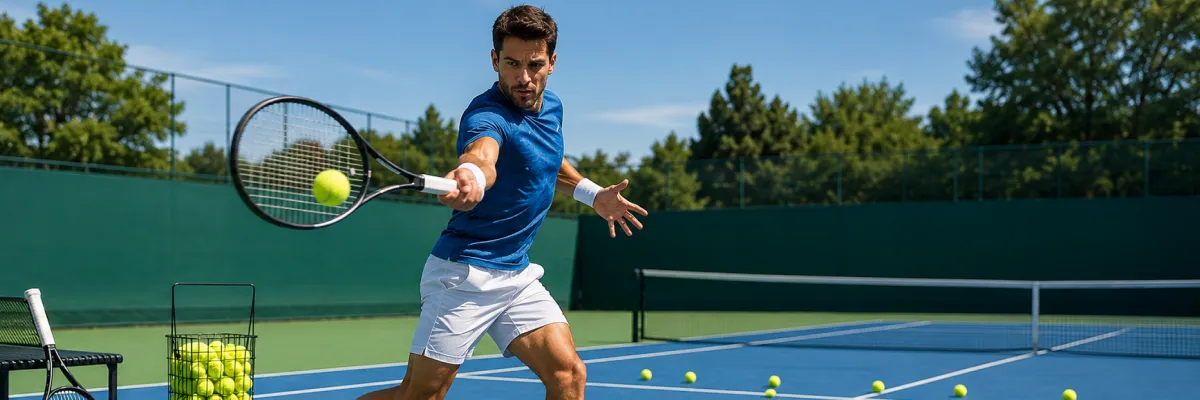
Basic tennis strokes: Forehand, Backhand, Service and Volley
Tennis is one of the most popular sports for sports betting and entertainment. To better understand tennis, whether you are playing or betting, it is essential to know the basic tennis strokes: forehand, backhand, serve and volley. This article explains in detail these fundamental techniques, how they influence the game and how they can help you analyze matches for informed betting on AdmiralBet.
What are basic shots in tennis and why do they matter?
The basic tennis strokes are the technical pillars of any player, regardless of level. They include the forehand, backhand, serve and volley. Each stroke has its own strategic and technical role, and mastering them is essential for success on the court, but also for accurate match analysis when placing sports bets on tennis .
- Forehand: This is usually the most powerful and natural shot for most players, used to dictate the pace of the point.
- Backhand: Can be executed with one or two hands and offers versatility, control and excellent tactical options in ball exchanges.
- Serve: Opens every point and can be a decisive weapon, putting the opponent in difficulty from the first hit.
- Volley: It is executed directly from the air and allows for quick completion of points at the net, before the ball touches the court.
Why do these hits matter?
Because they determine the style of play, the ability to control the ball and dictate the pace of the match. In addition, when analyzing matches for betting at AdmiralBet, knowing these techniques helps you identify the strengths and weaknesses of players, anticipate the development of points and assess the real chances of each athlete.
How does the playing surface influence the effectiveness of basic shots?
The playing surface (clay, grass, hard) can radically change the effectiveness of basic shots. For example, on clay, the ball bounces higher and slower, favoring long drives and spin shots. On grass, the serve and volley become more important due to the low bounce and speed, while on hard, the forehand and powerful serve are decisive.
Basic tennis strokes not only define each player's style, but also how you approach match analysis and sports betting.
Forehand in tennis: Technique, variations and strategic role
The forehand is considered the most natural and accessible shot in tennis. Most players use it as their main weapon, as it is the shot that can generate the most winners and control the court.
Basic forehand technique
The forehand stroke involves the dominant arm moving from back to front, with contact with the ball occurring at the side of the body. Foot position, racket grip, and torso rotation are key elements in generating power and control. There are several types of grips (Eastern, Semi-Western, Western), each influencing the angle and effect of the stroke.
Essential steps for an effective forehand:
- Correct grip on the racket
- Lateral body positioning
- Trunk rotation before contact
- Hitting the ball in front of the body
- Arm shot tracking
Forehand variations
Depending on the situation and surface, the forehand can be:
- Flat: Fast shot with a low trajectory, ideal on hard or grass.
- Topspin: A shot with an upward effect, used to lift the ball over the net and make it bounce higher, effective on clay.
- Slice: A downward-sloping shot used to change the rhythm and surprise the opponent.
The role of the forehand in sports strategy and betting
A strong forehand can dictate the pace of the match, force errors from the opponent and generate direct points. In match analysis for betting at AdmiralBet, observing the efficiency of a player's forehand provides clues about their chances on different surfaces or against certain opponents.
Backhand in Tennis: Types, Execution and Tactical Importance
The backhand is the second most fundamental shot in a tennis player's arsenal. While it may seem more difficult than the forehand to many, a solid backhand can make the difference in close matches and is often an indicator of a player's technical level.
Types of backhands
There are two main backhand variations:
- One-handed backhand: Offers more variety and angles, but requires superior strength and technique. It is preferred by players like Roger Federer.
- Two-handed backhand: Provides stability and control, is easier to learn and effective against spin or powerful balls. It is used by most modern players.
Correct execution of the backhand
Regardless of the variant, the execution of the backhand involves:
- Lateral positioning to the net
- Proper grip (Eastern or Continental for one hand, Semi-Western for two hands)
- Trunk rotation and weight transfer to the front leg
- Hitting the ball in front of the body, with fluid movement of the arm(s)
- Completing the over-the-shoulder shot
The backhand can be executed:
- Flat: For fast and direct hits
- Topspin: For control and safety, especially on clay
- Slice: For variation and change of pace
The importance of the backhand in your strategy
A vulnerable backhand can be exploited by opponents, while a solid backhand provides security on the baseline and the ability to counterattack. In match analysis for betting at AdmiralBet, observing the type of backhand and its effectiveness can indicate whether a player will withstand pressure or give in in long rallies.
One-handed vs. two-handed backhand
Characteristic | A hand | Two hands |
Power | Average | Great |
Control | Good | Very good |
Variation | high | Average |
Ease of learning | More difficult | Easier |
Adaptation to the effect | Average | Very good |
Tennis serve: Types, techniques and impact in analysis
The serve is considered the most complex and important opening shot in tennis. Every point begins with the serve, and the effectiveness of this shot can decide the fate of a set or even a match.
Service types
There are three main types of service:
- Flat serve: Fast, with a low trajectory, ideal for scoring aces (direct points).
- Slice service: The ball takes on a side effect, deflects after contact with the ground and can push the opponent to the side.
- Topspin serve: The ball bounces higher after contact, making it safer but less fast.
Service technique
An efficient service requires:
- Continental socket (similar to a hammer)
- Throwing the ball overhead, in front of the body
- Knee bending and weight transfer
- Hitting the ball at the highest point
- Tracking the shot with the arm and stepping onto the field
Key elements for good service:
- Accuracy (ball placement in corners)
- Speed (to get aces)
- Variation (alternation of effects and trajectories)
The impact of the service in strategy and betting AdmiralBet
A strong serve can bring quick points and put pressure on your opponent. In match analysis and live betting , statistics on ace percentage, first serve points or efficiency on fast surfaces provide valuable information for informed betting.
Tennis Volleyball: Execution, Use, and Tactical Relevance
The volley is the shot executed before the ball hits the ground, usually at the net. Although modern tennis relies more on baseline exchanges, the volley remains essential for players who adopt an offensive style or for decisive moments in a match.
Volleyball technique
For an effective volley:
- The racket's socket is Continental type.
- Body positioning is slightly tilted towards the net
- The arm is held firmly, with short, controlled movement
- The ball is hit in front of the body, without a wide swing
- The legs are flexed, ready for quick reaction
Types of volleyball
- Forehand volley: Executed on the dominant side
- Backhand volley: On the opposite side
- Smash volleyball: Powerful finishing shot, similar to a serve
The usefulness of volleyball in strategy and betting AdmiralBet
Volleying allows you to shorten points, put pressure on your opponent and capitalize on short balls. Players with good volleys can change the pace of the match and surprise their opponents. In match analysis for betting at AdmiralBet, volleying efficiency can indicate whether a player will be able to finish points quickly or will be vulnerable to passing shots.
How does the playing surface influence the effectiveness of basic shots?
The playing surface is a determining factor in tennis, significantly influencing the effectiveness of basic tennis shots. At AdmiralBet, knowing these details helps you better analyze matches and make informed sports betting decisions.
Slag
On clay, the ball bounces higher and travels slower. This makes topspin forehands and spin backhands more effective. Clay court players use long swings, lifts, and patience to dominate their opponents.
Grass
Grass favors strong serves and volleys because the ball bounces low and fast. Players with good serve-volleys and reflexes at the net have a clear advantage. Flat, fast shots are more effective than those with a lot of spin.
Hard surfaces
Hard courts offer a balance between clay and grass. A strong forehand, a precise serve and a stable backhand are crucial. All-court players, who can vary their shots and adapt quickly, have the best chance of success.
The efficiency of basic strokes on different surfaces
Coup | Slag | Grass | bucket |
Forehand | Topspin | Flat | Mix |
Backhand | Topspin/Slice | Flat/Slice | Topspin/Flat |
Service | Slice/Topspin | Flat/Slice | Mix |
volley | Less often | Very efficient | Efficient |
Glossary of essential tennis terms
To successfully navigate the world of tennis and sports betting at AdmiralBet, it is useful to know the most important terms used in tennis:
- Forehand: A shot executed on the dominant side of the body.
- Backhand: A shot executed on the side opposite the dominant hand.
- Service: The opening shot of each point.
- Volleyball: Hitting the net without the ball touching the ground.
- Topspin: A shot with an upward effect, the ball bounces higher.
- Slice: Shot with a downward effect, the ball bounces lower.
- Smash: A powerful overhead hit, similar to a serve.
- Passing shot: A shot that passes past the opponent at the net.
- Break: Winning a game on the opponent's serve.
- Tie-break: Decisive game for sets tied at 6-6.
Knowing these terms helps both in understanding sports broadcasts and in interpreting statistics and analysis.
Basic tennis shots and betting analysis
Understanding basic tennis shots is useful not only for players, but also for bettors, as it allows for a more detailed analysis of matches and the chances of each athlete.
How do you use knowledge about shots in match analysis?
- Analyze playing style: A player with a strong forehand will try to dictate the pace, while one with a solid backhand will withstand pressure better.
- Evaluate service efficiency: Players with a high percentage of aces and points won on first serve have better chances on fast surfaces.
- Observe adaptability to the surface: A player who adjusts his basic shots according to the terrain will have a strategic advantage.
- Follow live news: AdmiralBet offers real-time data on ongoing tennis matches.
Tennis betting options at AdmiralBet
- Match result
- Total number of games/sets
- Winner set
- Bets on aces, double faults, breaks
- Live betting with cash-out
By integrating knowledge of basic techniques and statistical analysis, you can make more informed and responsible decisions when betting on tennis on the AdmiralBet platform.
Frequently asked questions
How does service efficiency influence live betting odds?
The serve is the only shot that is not influenced by the opponent. A high percentage of first serves or a high number of aces quickly stabilizes service games, lowering the odds on favorites and generating good options for betting on the number of games or aces per match.
What tactical difference does a two-handed backhand offer in an official match?
Players with a two-handed backhand return strong serves much more effectively and hold up better in extended rallies on the baseline, a crucial detail for analysis on slow surfaces like clay.
How important is volleyball efficiency in singles matches?
Net efficiency indicates a player's ability to shorten points and put pressure on the opponent, being an excellent indicator for analyzing matches on fast surfaces (grass, hard), where the percentage of points won at the net can decide the outcome.